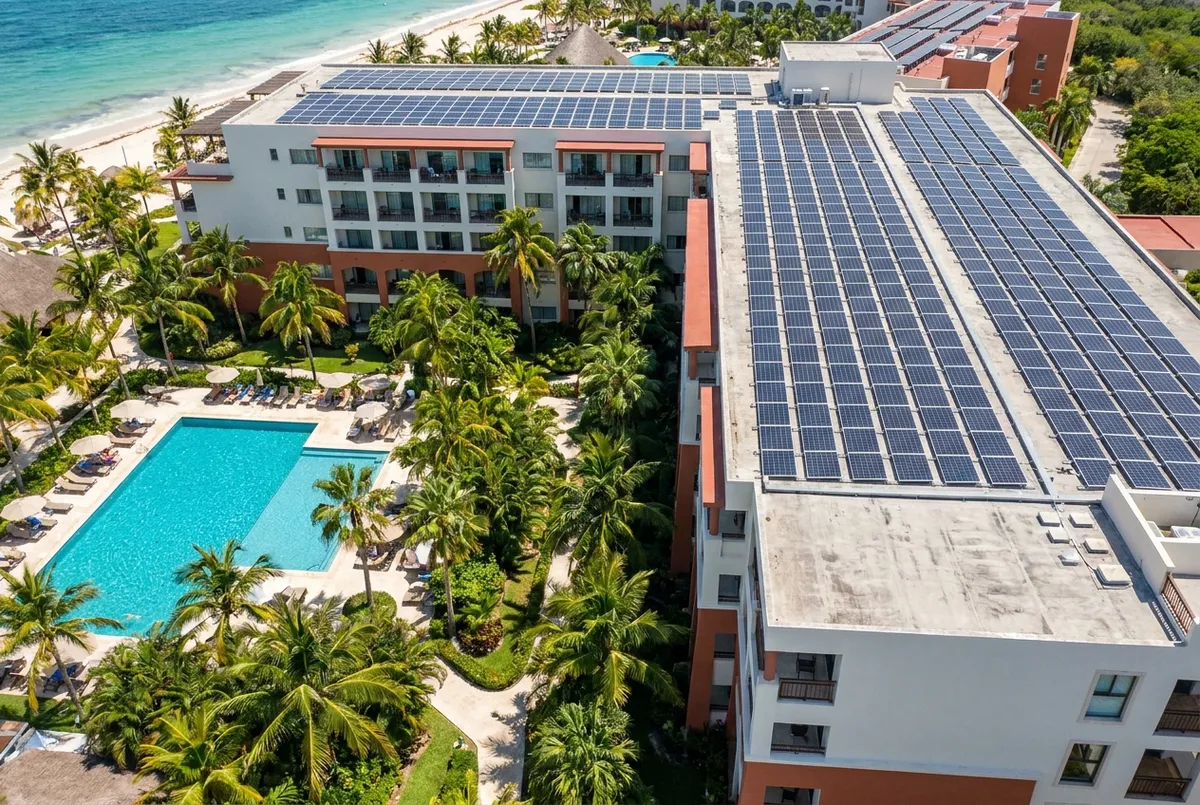
Commercial properties are where solar economics in Bali genuinely shine, and as a designer I find them more satisfying than any villa job. A hotel's load curve — laundry, kitchens, pool pumps, lobby cooling, guest air conditioning that guests run all afternoon — peaks at almost exactly the hours the array produces. That means 90%+ self-consumption with no battery at all, which is the single biggest driver of payback. Add PLN's business tariffs and the arithmetic gets better still: most 50 kWp hotel systems we model pay back in four to five years against a 25-year asset life.
What's Included
Energy Audit First
We analyse twelve months of PLN bills and log your three-phase load profile across a typical week — occupancy patterns included — before a single panel is specified.
Three-Phase Engineering
Commercial-grade string inverters balanced across phases, power-factor considerations, grid-protection settings to PLN requirements and integration with existing generators and capacitor banks.
Phased Installation
Roof zones are built section by section around your operations — no closed rooms, no kitchen downtime, crane lifts scheduled for low-occupancy mornings. Most 50 kWp builds complete in 2–3 weeks.
O&M Contract
Quarterly cleaning, thermographic inspection, inverter servicing and monitoring with monthly production reports — output guarantees available for systems we design and build.
The Business Case for Bali Hospitality
Take a mid-size resort spending IDR 60,000,000 a month with PLN. A 75 kWp array on its roofs produces roughly 9,500 kWh a month — call it 15–18 million rupiah of avoided purchase at business tariffs, almost all self-consumed because the load is there when the sun is. Against an installed cost of around IDR 850,000,000, that is payback inside five years, then twenty years of materially lower operating costs — plus a sustainability story that increasingly matters in booking decisions. We build the full cash-flow model for your finance team as part of the proposal, using the same conservative method described in our solar cost and payback analysis.
For properties with evening-heavy loads — beach clubs, restaurants — we model battery storage honestly: sometimes it earns its keep, often it does not yet, and we will show you the difference in numbers. Critical-load backup for reception, refrigeration and security through PLN outages is a more common justification — effectively a commercial-scale hybrid system. Every project starts with the audit, which works exactly like our villa design service, scaled up.
How We Work
Share twelve months of bills
PLN bills and a roof plan or drone shot on WhatsApp or email. We come back with a feasibility range within days.
Audit and engineering proposal
Load logging on site, structural review of the roofs, full system design and a board-ready financial model with conservative assumptions.
Phased construction
Built zone by zone around occupancy, with PLN liaison for the three-phase interconnection handled by us throughout.
Commissioning and O&M
Performance verification against the model, staff handover, monitoring dashboards, and a maintenance contract that keeps output where the model says it should be.
What It Costs
At commercial scale, installed cost falls to roughly IDR 11,000,000–13,000,000 per kWp depending on roof type and electrical complexity — a 50 kWp system from around IDR 600,000,000. O&M contracts from IDR 2,500,000 per month including quarterly cleaning and reporting. Indicative tiers are on the pricing page; every commercial quote follows its own audit.
Frequently Asked Questions
What size system does a hotel in Bali need?
Will installation disrupt our guests?
Does a commercial system need batteries?
Can the system run our property during a PLN outage?
What about PLN permits for a large system?
Solar Coverage Across Bali
Cut Your Property's Biggest Utility Cost
Send twelve months of PLN bills — we reply with a feasibility range and a date for the full energy audit.
Request a Feasibility Study