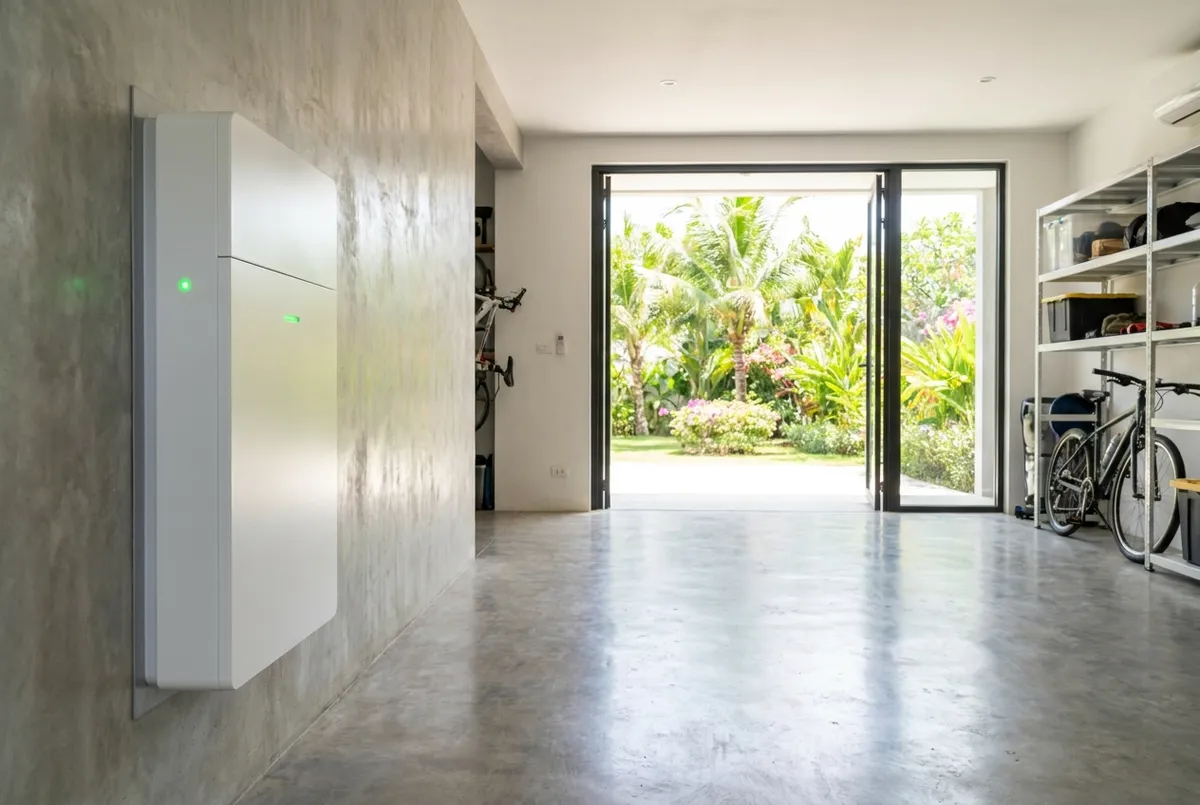
Two things changed the battery conversation in Bali. First, PLN stopped crediting exported solar one-to-one, so the energy your panels send to the grid at noon is now worth far less than the energy you buy back at night — storing it yourself is the obvious fix. Second, LiFePO4 prices fell hard: a 5 kWh bank that cost 60 million rupiah a few years ago now starts at 25. As a designer I treat the battery as the heart of the system — it is the component that works hardest, degrades first if abused, and rewards correct sizing more than anything else on the roof.
What's Included
LiFePO4 Chemistry Only
Lithium iron phosphate: 6,000+ charge cycles, stable at tropical ambient temperatures, and no thermal-runaway drama. We do not install lead-acid banks — in Bali's heat they die in two to three years.
Sizing From Essential Loads
We list what must run — fridge, lights, WiFi, pumps, selected AC — measure the draw, and size the bank in kWh for your real evening and blackout pattern, not a round marketing number.
BMS & Monitoring
Every bank ships with a battery management system protecting each cell, plus app monitoring of charge level, cycles and temperature alongside your solar production.
Retrofit or New Install
We add storage to existing grid-tied systems — directly on compatible Growatt and Deye inverters, or AC-coupled on anything else — and design battery-first hybrid systems from scratch.
Why LiFePO4 and Not Lead-Acid or NMC
Battery chemistry matters more in Bali than almost anywhere, because heat is the enemy of every battery and our plant rooms sit at 30–34°C year round. Lead-acid banks — still sold here because they are cheap upfront — lose half their rated cycles above 30°C and usually need replacing within three years, which makes them the most expensive option per stored kilowatt-hour. NMC lithium handles heat poorly too and brings thermal-runaway risk into your villa. LiFePO4 tolerates tropical temperatures, delivers 6,000+ cycles at 80% depth of discharge, and is the only chemistry we are willing to put a 10-year warranty behind.
A battery is most valuable as part of a properly designed system: paired with a hybrid inverter it gives you blackout backup, and paired with a correctly sized array from our installation service it shifts your free midday energy into the expensive evening hours. Whether the maths favours adding storage now or later is exactly the kind of question our load calculation answers with numbers instead of sales talk.
How We Work
Send your inverter model and goals
A photo of your existing inverter (if any) and what you want the battery to do — evening self-use, blackout backup, or both.
Compatibility check and sizing
We confirm whether your system takes a battery directly or needs AC coupling, then size the bank from your essential loads and consumption pattern.
Installation in 1–2 days
Bank mounting in a ventilated space, BMS configuration, essential-load wiring and protection. Retrofits on compatible inverters are usually a single day.
Blackout test and handover
We cut the mains and verify the switchover live, then set up monitoring on your phone and hand over warranty documents.
What It Costs
Installed LiFePO4 storage starts from IDR 25,000,000 for 5 kWh, IDR 48,000,000 for 10 kWh and IDR 70,000,000 for 15 kWh, including BMS, cabling, protection and configuration. AC-coupled retrofits add the coupling inverter. If you are starting from zero, a full hybrid package is usually better value — compare on the pricing page.
Frequently Asked Questions
How long will a battery power my house?
How long do LiFePO4 batteries last in Bali's climate?
Lead-acid is cheaper — why not use it?
Can I add a battery to my existing solar system?
Where should the battery be installed?
Solar Coverage Across Bali
Store Your Sunshine
Send a photo of your inverter or PLN bill on WhatsApp — we reply the same day with the right battery size and a fixed price.
Get a Battery Quote