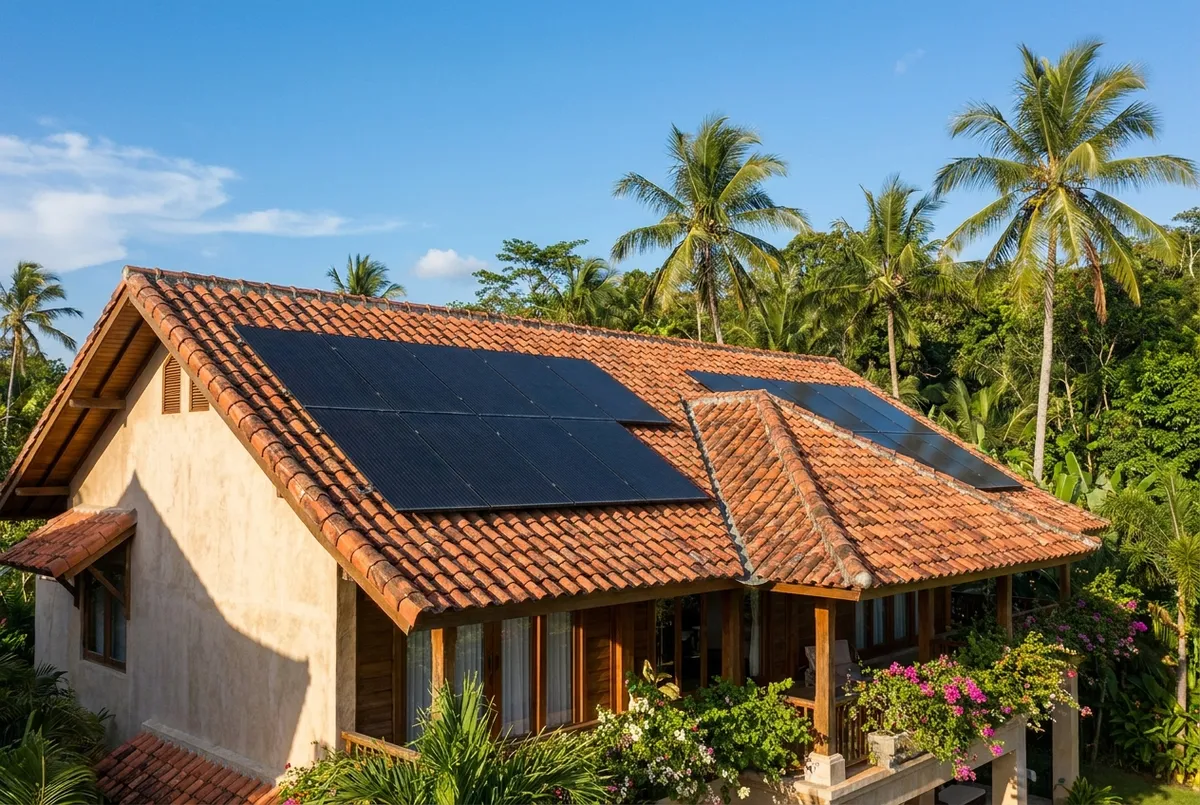
The first thing we tell every villa owner is the same: the panels are the easy part. A typical villa here burns 900–1,500 kWh a month — air conditioning, a pool pump, a water pump — and at PLN's R-2 tariff of IDR 1,699.53 per kWh that is a 2–3 million rupiah bill, every month, forever. A correctly sized grid-tied system erases most of the daytime portion of that bill. An incorrectly sized one wastes your money on panels that export for nothing. That is why every installation we do starts with your PLN bill and a load calculation, not with a panel count.
What's Included: Survey, Tier-1 Panels, Inverter, Protection, PLN Paperwork
Site Survey & Shading Analysis
We measure your usable roof area, orientation and tilt, and map shading from trees, water tanks and neighbouring buildings hour by hour. Ten percent shading on one string can cost thirty percent of output if the design ignores it.
Tier-1 Panels & Mounting
550–620 Wp monocrystalline panels from Tier-1 manufacturers, on anodised aluminium rails with stainless hardware — clay tile, metal deck and flat concrete roofs all have their own mounting system.
Inverter & Protection
Growatt, Deye or SMA string inverters sized to the array, with DC isolators, surge protection on both sides and a dedicated AC breaker. Lightning is real in Bali — we never skip the SPDs.
PLN Paperwork & Net Metering
We prepare the export-import metering application, SLO inspection documents and PLN submission for you. You sign; we chase the process until the meter is swapped.
How We Size a Villa System: From Your PLN Bill, Not Your Roof
Bali gets an average of 4.0–4.3 peak sun hours per day across the year, which means every 1 kWp of well-placed panels produces roughly 120–130 kWh per month. Take your average monthly consumption from the PLN bill, look at how much of it happens in daylight, and the right system size falls out of the arithmetic. For most villas that lands between 5 and 10 kWp. We model it properly — including the rainy season months — as part of our system design and load calculation service, which is free when we do the installation.
One honest caveat: since PLN changed its rooftop solar rules, exported energy is no longer credited one-to-one. A grid-tied system makes the most financial sense when you consume the power as you generate it — pool pumps and air conditioning running in the afternoon are perfect. If your big loads run at night, or your area suffers blackouts, look at a hybrid system with battery storage instead. We will tell you straight which one your numbers support, and the full maths is in our solar cost and payback article.
How Much a Bali Villa Saves With Rooftop Solar
Savings come from replacing the most expensive units on your PLN bill with power your roof produces during the day. A south-Bali villa running air conditioning, a pool pump and a kitchen draws most heavily in daylight — exactly when an on-grid array generates. PLN charges IDR 1,444.70 per kWh on the R-1 tariff (1,300–2,200 VA) and IDR 1,699.53 on R-2 and R-3 (3,500 VA and up), so every kWh the panels cover on site saves that amount.
| Monthly PLN bill (R-2) | System | Production / month | Bill saving / month | Simple payback |
|---|---|---|---|---|
| IDR 1,500,000 (~880 kWh) | 3 kWp, from IDR 42M | ~380 kWh | ~IDR 650,000 | ~5.4 years |
| IDR 2,500,000 (~1,470 kWh) | 5 kWp, from IDR 65M | ~640 kWh | ~IDR 1,090,000 | ~5.0 years |
| IDR 4,000,000 (~2,350 kWh) | 8 kWp, from IDR 98M | ~1,000 kWh | ~IDR 1,700,000 | ~4.8 years |
| IDR 5,000,000 (~2,940 kWh) | 10 kWp, from IDR 120M | ~1,280 kWh | ~IDR 2,175,000 | ~4.6 years |
The table is a calculation, not a promise: it assumes the villa uses everything the panels make as they make it, which holds when at least 45% of your consumption falls in daylight hours. The exact figure depends on your tariff class, your day-versus-evening pattern and the roof. A villa occupied during the day and cooled all afternoon gets the strongest on-grid return; a property used mostly at night gets more from a hybrid system that stores the day's sun in a battery. The full breakdown, with a payback calculator, is in our solar cost and ROI article.
On-Grid for Villas: When It Pays and When a Hybrid Is Better
An on-grid (grid-tie) system connects the array and inverter to the PLN supply. During the day the panels power the villa; at night you use PLN as normal. It is the cheapest configuration per kWp and has no battery to replace — but the inverter switches off during a blackout, by design, to protect PLN line crews working on the fault.
Under Permen ESDM No. 2/2024, surplus power you export is no longer deducted from a new customer's PLN bill, so an on-grid system pays only through the energy the villa uses as it is generated. That is why we size to your daytime load instead of filling the roof: pool pumps, afternoon AC, laundry and a water heater on a timer are the loads that make on-grid pay. Stable-grid areas such as Sanur, Denpasar and Nusa Dua suit it best.
If your big loads run at night, or your street loses power every week — common in Canggu, Berawa and Uluwatu — we fit a hybrid-ready inverter so a battery can be added later with no rewiring. Compare the three options in our on-grid, hybrid or off-grid guide, or go straight to off-grid and hybrid systems.
How We Work: PLN Bill on WhatsApp to Handover in About a Week
Send your PLN bill on WhatsApp
A photo of the bill and a few photos of the roof. We reply the same day with a recommended system size and a price range.
Survey and fixed quote
We visit, measure the roof, check the electrical panel and shading, and confirm a fixed quote with a production estimate in kWh per month.
Installation in 2–4 days
Mounting, panels, inverter, cabling and protection — most villa systems are installed and commissioned within a week of deposit.
Commissioning and handover
We test every string, register the monitoring app on your phone, hand over documentation and start the PLN metering process.
What It Costs: 3 kWp From IDR 42M, 5 kWp From IDR 65M
A 3 kWp starter system is from IDR 42,000,000 installed; 5 kWp — the most common villa size — runs from IDR 65,000,000; 10 kWp from IDR 120,000,000. Prices include Tier-1 panels, inverter, mounting, protection, installation and PLN paperwork. Battery storage, if you want blackout backup, is priced separately. Full tables, including hybrid systems and water heaters, are on our pricing page.
Frequently Asked Questions
How much does solar panel installation cost in Bali?
How long does installation take?
Which roofs can you install on?
Does solar still work in the rainy season?
Can I monitor what my system produces?
Solar Coverage Across Bali
Send Your PLN Bill — Get a kWp Size and Fixed Quote
WhatsApp a photo of your PLN bill and your roof — the reply comes back the same day with a recommended system size and an honest fixed quote.
Send PLN Bill & Roof Photos