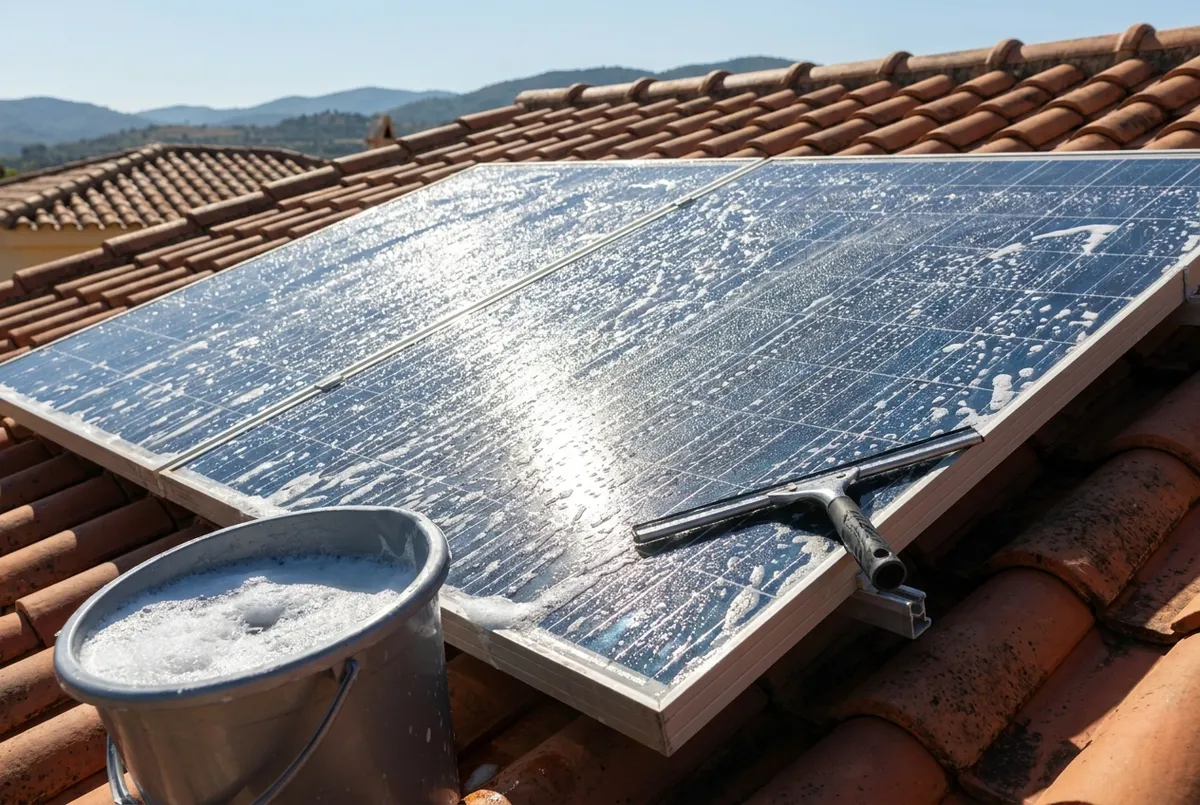
The dirtiest panels I see in Bali are always in the dry season, which surprises owners — they assume rain is the problem, when rain is actually the free cleaner. From May to October there is no rain to rinse anything, so road dust, dry-season burning ash and salt film near the coast build into a stubborn layer, glued on by morning dew. Add a few bird droppings shading individual cells and a villa array quietly loses 10–25% of its production. The fix costs IDR 600,000 and pays for itself within a few months; the proof is in the inverter data, which is why we photograph output before and after every clean.
What's Included
Deionised Water & Soft Brush
Mineral-free water and solar-rated soft brushes — no detergents that leave film, no hard mains water that bakes mineral spots onto hot glass, no pressure washers that stress seals.
Output Check Before & After
We record inverter production before we start and after we finish, so you see the recovered percentage in numbers, not promises. Typical recovery on a neglected array: 8–20%.
Full Visual Inspection
While we are on the roof: connectors, cable insulation, mounting torque, glass cracks, hotspot discolouration and any new shading. Small faults get photographed and reported.
Maintenance Plans
Twice-yearly cleaning and inspection on a schedule — once mid dry season, once after the rains — with priority callout if your monitoring shows a fault between visits.
What Dirt Actually Costs You
Uniform dust haze costs a few percent; the expensive dirt is the concentrated kind. A single bird dropping shading one cell drags down its whole string, and near roads or rice fields the mix of dust and exhaust film builds a layer that light measurably struggles through. On a 5 kWp villa system producing ~640 kWh a month, a 15% loss is nearly 100 kWh — around IDR 165,000 of electricity every month at R-2 tariff, more than the cost of cleaning twice a year. Coastal arrays in Canggu, Seminyak and Uluwatu also collect salt film, which is conductive and accelerates connector corrosion on top of the output loss.
Single-storey roof and confident with a hose? Honest answer: you can do a basic clean yourself, and we wrote a step-by-step guide — how to clean your own panels without wrecking them — covering the hard-water and midday-heat mistakes that crack glass and void warranties. Two-storey roofs, steep tile, or output that stays low after cleaning are professional territory: low production with clean panels usually means a connector or inverter issue, which our inverter repair service diagnoses properly. Not our installation originally? No problem — most arrays we maintain were installed by someone else.
How We Work
Send your system size and location
Number of panels and a roof photo on WhatsApp — we quote the visit immediately.
Cleaning visit
Early morning or late afternoon, never on hot midday glass. Deionised water, soft brush, frame and drainage check.
Inspection report
Photos of anything that needs attention — loose connectors, cracked glass, new shading — with honest advice on what matters and what can wait.
Before/after numbers
You get the output comparison from your own inverter data, so the value of the visit is visible in kWh.
What It Costs
A standard villa array (up to 12 panels) is from IDR 600,000 per visit; larger systems priced per panel. A twice-yearly maintenance plan with inspection report is from IDR 1,800,000 per year and includes priority fault callout. Commercial arrays quoted per kWp — see the pricing page.
Frequently Asked Questions
How often should solar panels be cleaned in Bali?
Doesn't the rain clean the panels?
How much output will cleaning recover?
Can I clean the panels myself?
Solar Coverage Across Bali
Get Your Kilowatts Back
Send a roof photo and panel count on WhatsApp — we quote the clean immediately and bring the before/after numbers.
Book a Cleaning Visit